Orynr Code Help
Everything you need to get going with Orynr Code: installing it, connecting a model, working with the agent team, keeping projects safe, and fixing anything that misbehaves.
Installing
Orynr Code is free. It runs on Windows 10 and 11 (64-bit) and installs for your user only, so it needs no administrator rights and nothing else: no Python, no Node.js.
- Download
orynr_code_setup.exefrom the Orynr Code page. Only download it from orynr.com. - Run it. Windows may show “Windows protected your PC” the first time; click More info → Run anyway. The file is signed by Orynr LLC.
- Read and accept the licence, choose the folder (the default is fine) and tick desktop shortcut if you want one.
- Finish. Start it from the shortcut, or open a new Command Prompt or PowerShell window and type
ora.
Check your download (optional)
Every release lists its SHA-256 fingerprint on the download section. In PowerShell, in the folder with the file:
(Get-FileHash .\orynr_code_setup.exe).Hash
If the result matches the published value, your copy is exactly the one Orynr released.
Your first chat
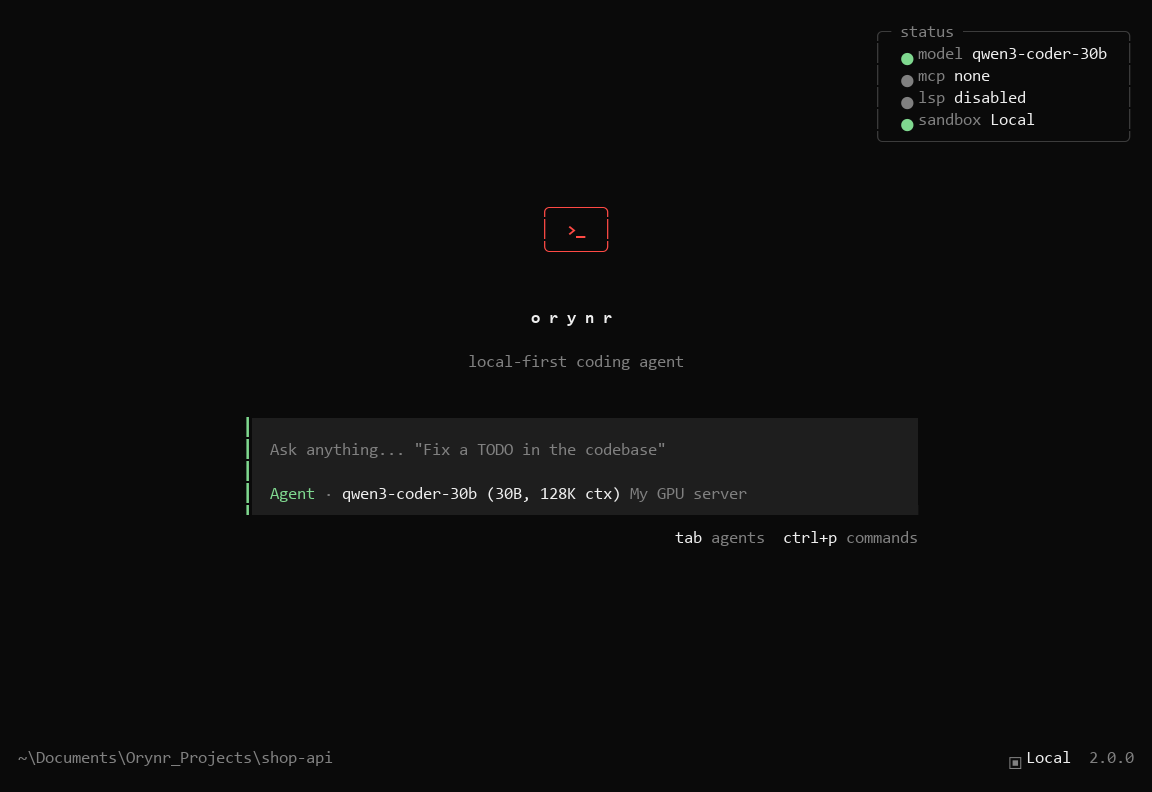
Orynr Code keeps projects in Documents\Orynr_Projects. When you start it with no project, the
first thing the Agent does is sort one out with you:
- Starting something new? Say what you want to build. The Agent suggests a short name (like
online-store), asks if it's OK, and createsDocuments\Orynr_Projects\online-storefor you. - Working on an existing folder? Just name it: “review the code in C:\Users\me\Desktop\MyApp”. The chat moves into that folder and works there, in place. Nothing is moved or copied.
- Open a folder directly from a terminal:
ora C:\path\to\project.
Connecting a model
Orynr Code doesn't come with an AI model; you choose one. It can be a cloud provider with your own key, or a model server you run yourself.
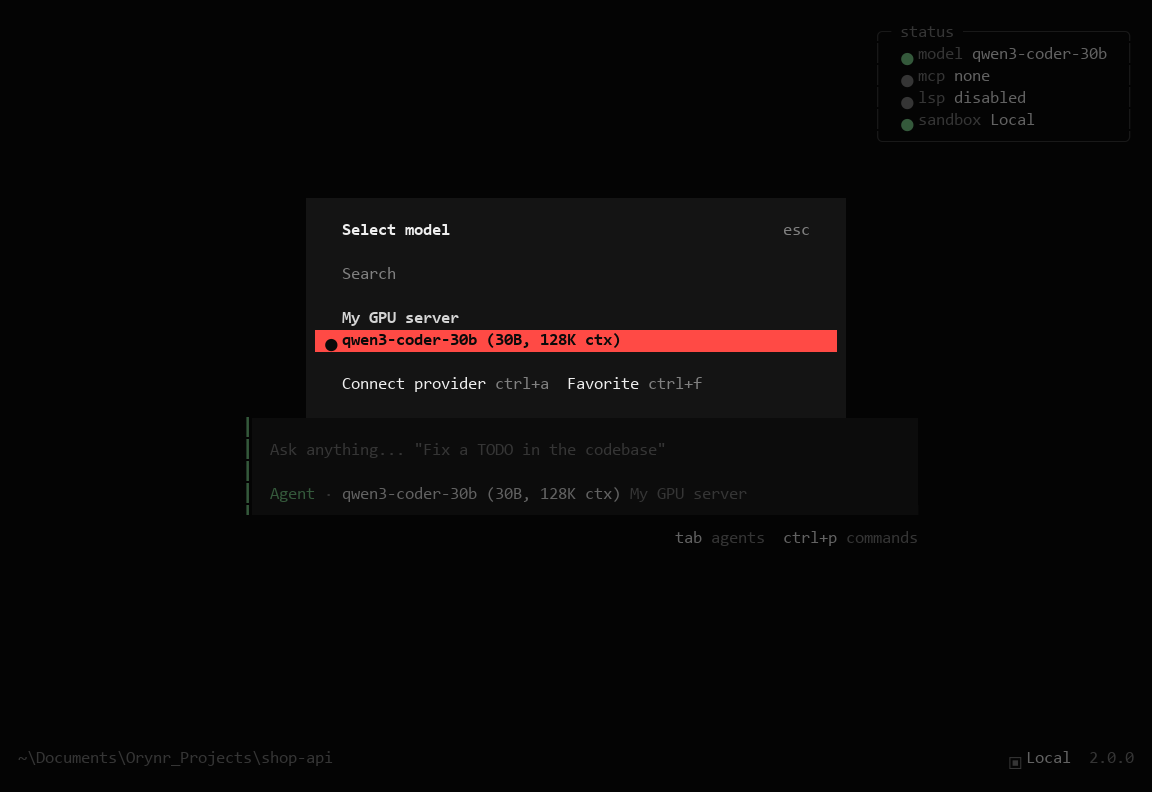
- Open the model picker with ctrl+x then m (or
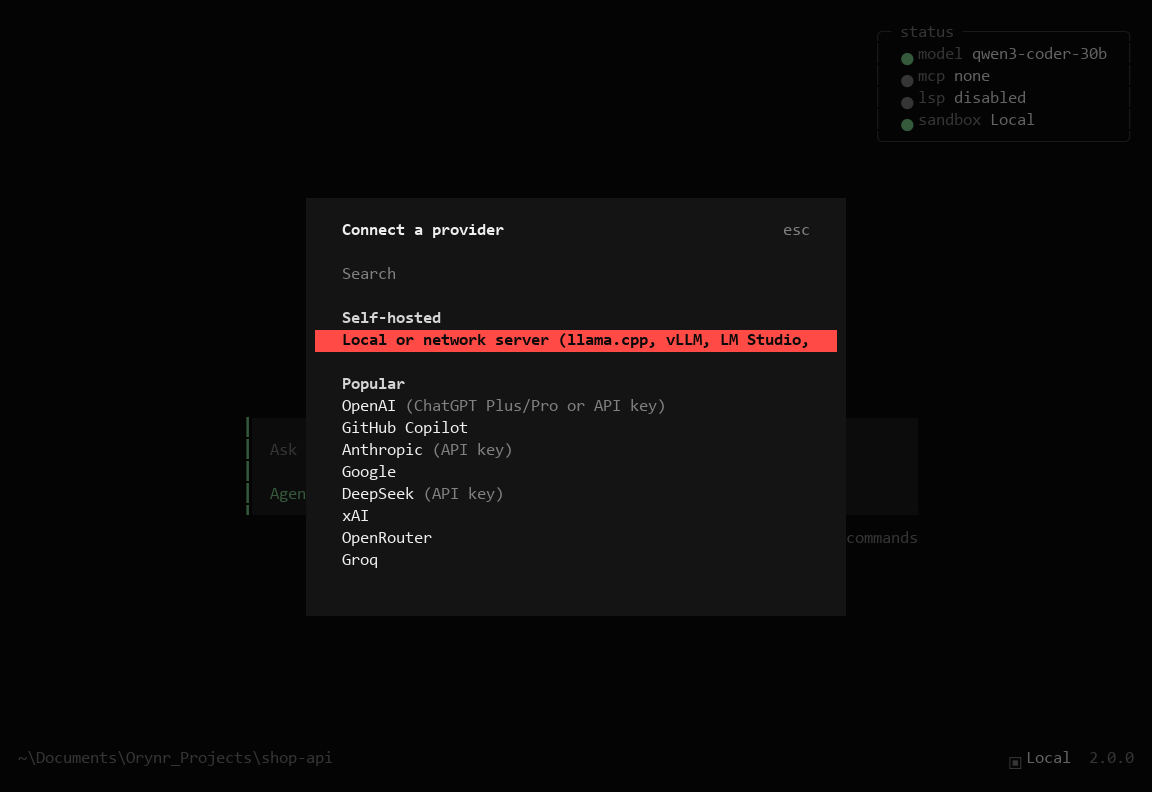
/models). - Press ctrl+a for Connect a provider.
- For your own server, pick Local or network server (top of the list). For a cloud service, pick it from the list and paste your API key.
- Choose a model from the picker. It shows up at the bottom of the prompt.
See Cloud providers and Your own model server for details.
The 60-second tour
| Press or type | To… |
|---|---|
| Enter | Send your message |
| Esc | Stop what it's doing right now |
| Tab / shift+Tab | Switch agent (Agent, Build, Plan, Autonomous…) |
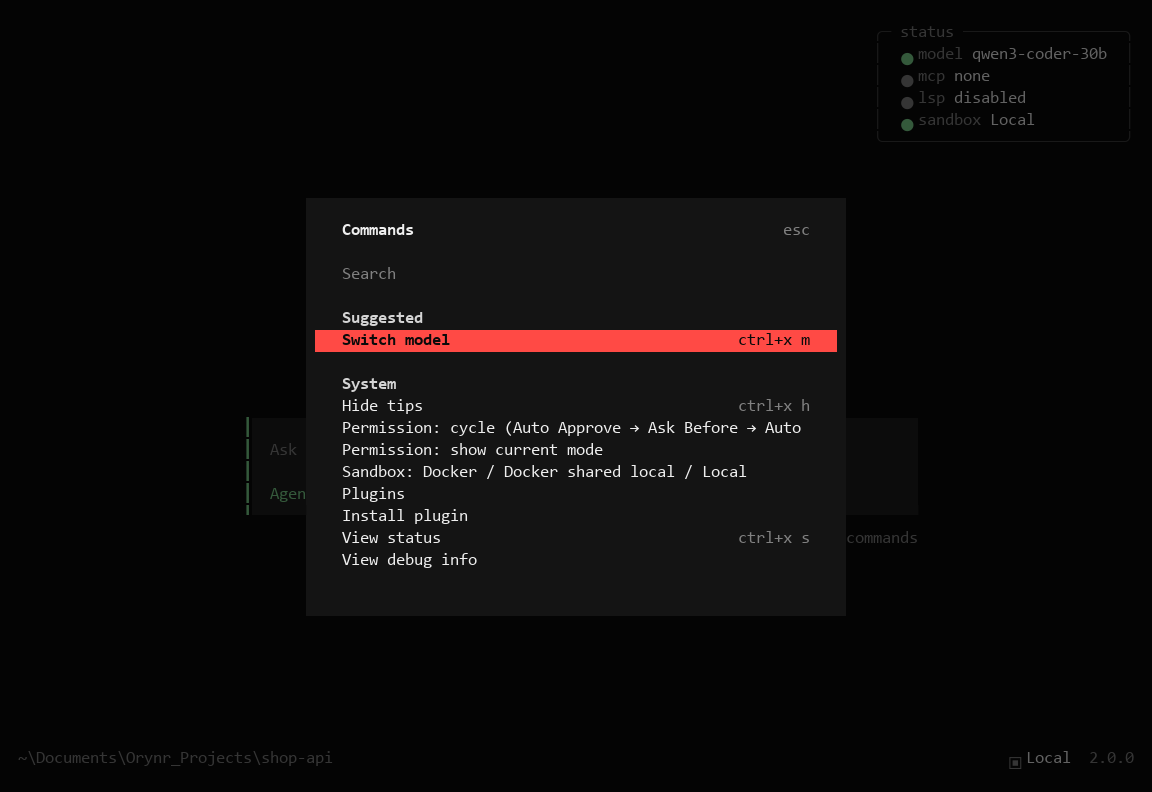
| ctrl+p | Command palette: every command, searchable |
| ctrl+x m | Pick a model (F2 jumps to the next recent one) |
| ctrl+t | Think mode on local models that support it |
| ctrl+x n / ctrl+x l | New session / list sessions |
| ctrl+x z | Watch the helper agents working |
/sandbox | See or change the project's mode (Docker / Docker shared local / Local) |
/mcps | Tool servers: add, switch on or off |
/undo / /redo | Roll your files back to before the last message, or forward again |
/permission | Change how often it asks before acting |
/themes | Change the look |
| ctrl+c | Quit |
The agent team
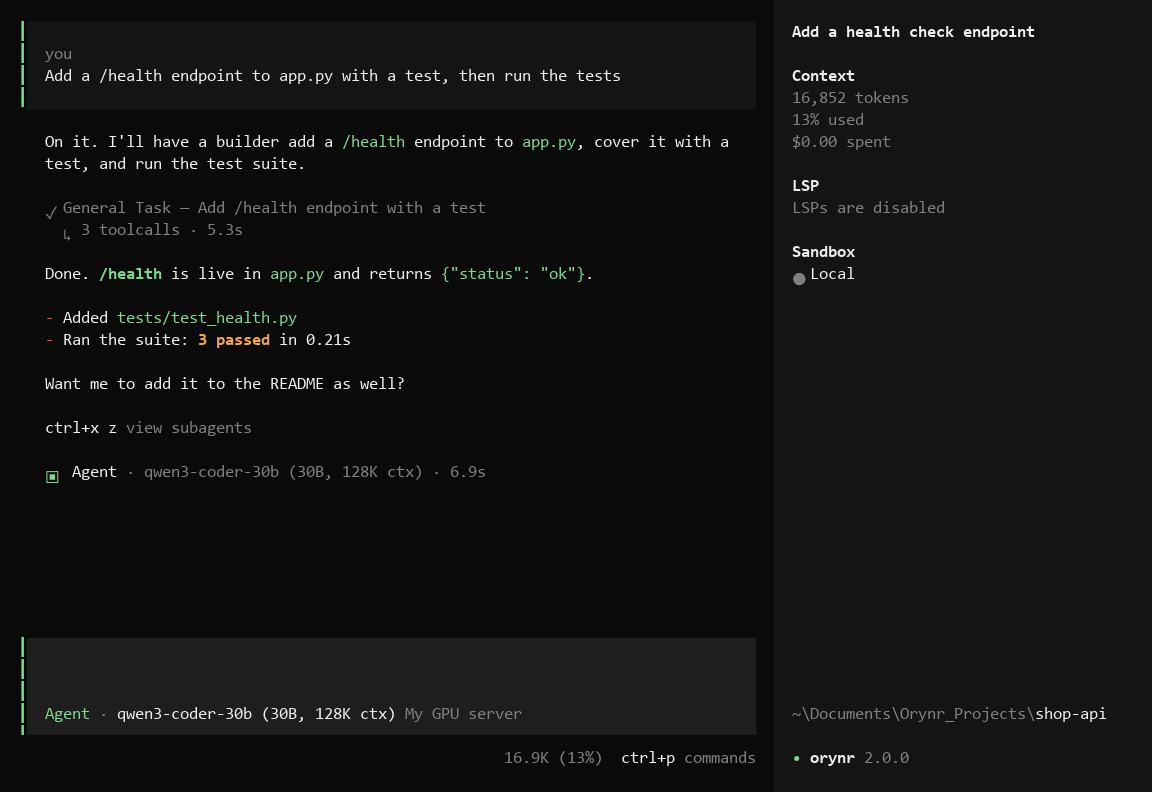
Orynr Code isn't one chatbot. The default Agent (Orynr) works out what you actually need, hands each piece to the right specialist, reviews their work, and reports back. If no specialist fits, it can build a new one on the spot. Press Tab to pick a mode yourself.
Agent Default
The orchestrator. Delegates, reviews, and builds new specialists when needed. Best for most requests.
Build
Does the work itself: edits files and runs commands. Direct and fast.
Autonomous
Keeps going on its own until the job is done and checked, working through its own to-do list.
Plan
Look but don't touch. Produces a plan without changing anything.
Research & Thinking
Investigate the web and your code in parallel, or reason through hard problems. Read-only.
Auditors
Code Analyzer, Risk Analyzer and Anomaly Reviewer find bugs, risky changes, leaked secrets and leftovers. Read-only.
Also available: Ralph (a relentless finisher for a spec), Chat (a switchboard that routes to specialists), Conversation (plain chat, touches nothing), Understanding and Mapping.
Talking while it works
You don't have to wait. Type a new message while the agent is busy and it stops, reads it, and changes course right away: “actually, use PostgreSQL instead.” The reply so far, your message and its answer stay in order in the chat.
Press Esc to stop completely.
Approvals
Before it runs a command or changes a file, Orynr Code asks. Here's how to answer.
- Allow once: just this action.
- Allow always: this kind of action from now on. The screen lists exactly what that covers before you confirm: for a command it's the program (for example
git status *, which does not includegit push), for file edits it's any file. - Reject: it won't do it. You can tell it what to do differently.
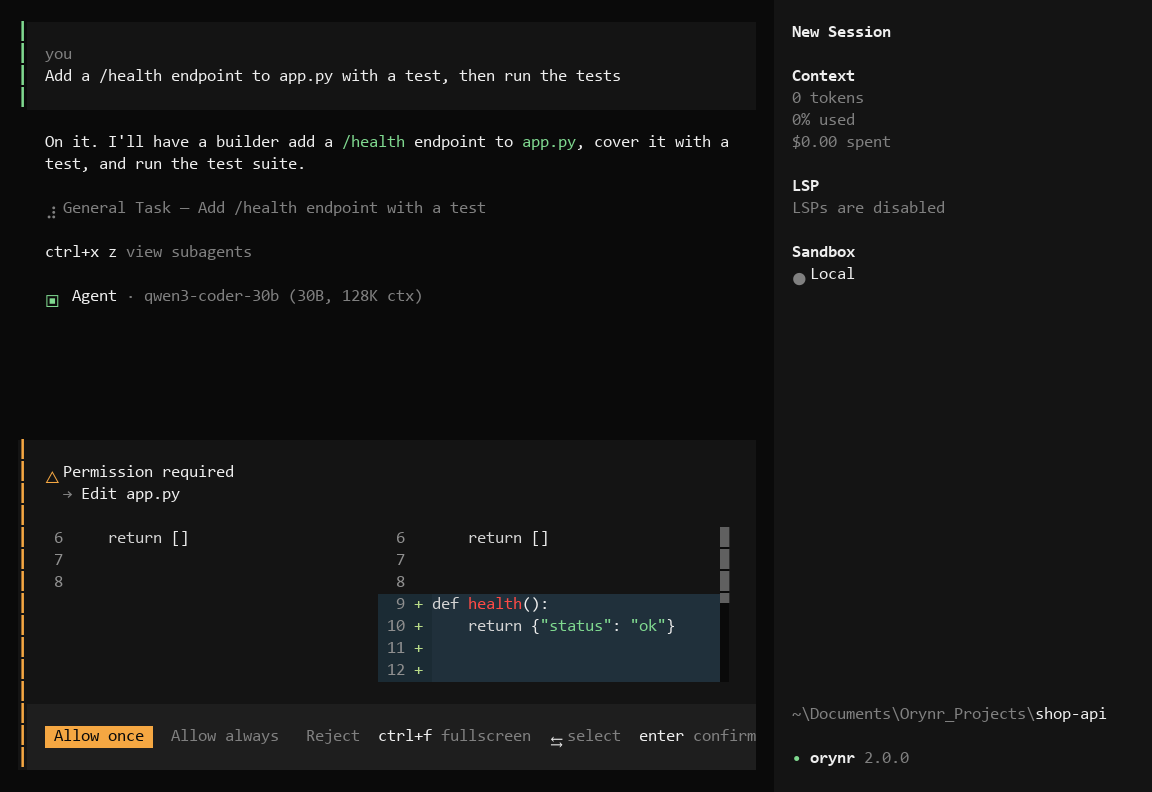
“Allow always” never lets a chained command slip through: cd src && rm -rf build still asks unless every part of it was allowed, and a command hiding another command inside it only runs as exactly approved.
How often it asks
/permission cycles between Auto Approve, Ask Before and Auto Decline. Start with Ask Before.
Undo & history
- Undo: before each message, your project files are snapshotted.
/undoputs them back to that point (it works even if the project doesn't use git);/redogoes forward again. - Sessions: every chat is kept per project. ctrl+x l lists them.
- Long chats are condensed automatically near the model's limit, so they never overflow.
/compactdoes it now. - Share a chat as a read-only page served from your own machine (
/share,/unshare), or/exportit.
Long jobs & retries
Orynr Code is built so a job never dies or goes quiet halfway.
- Long commands are fine. Installs, builds and test runs may take up to 30 minutes.
- “Timed out” isn't “failed”. If something is still running at its limit, it's stopped along with everything it started, and the agent checks what actually happened (is Python installed now? do the files exist?) before doing anything again.
- A model that doesn't answer is tried again, with a pause between tries, and you see it on screen: “trying again, attempt 2 of 6”.
- After 6 failed tries it tells you plainly what it was doing and what it found, instead of looping.
- A busy model server (for example a GPU box finishing someone else's job) is waited on for up to 30 minutes, with a “the model server is busy” line. Esc stops the wait any time.
Cloud providers
Orynr Code knows 75+ providers and thousands of models, including OpenAI, Anthropic, Google, DeepSeek, xAI, OpenRouter, Groq, Mistral, GitHub Copilot, Azure and Amazon Bedrock.
- ctrl+x m → ctrl+a → pick the provider.
- Paste your API key (or sign in, where the provider offers it).
- Pick a model.
Your own model server
Run your own model on this PC or another machine on your network? llama.cpp, vLLM, LM Studio, Ollama and any OpenAI-compatible server work.
- ctrl+x m → ctrl+a → Local or network server (first in the list).
- Type the address, for example
192.168.1.50:8080.http://and/v1are added for you. - Give it a name, like My GPU server.
- Type its API key if you started the server with one; otherwise leave it empty.
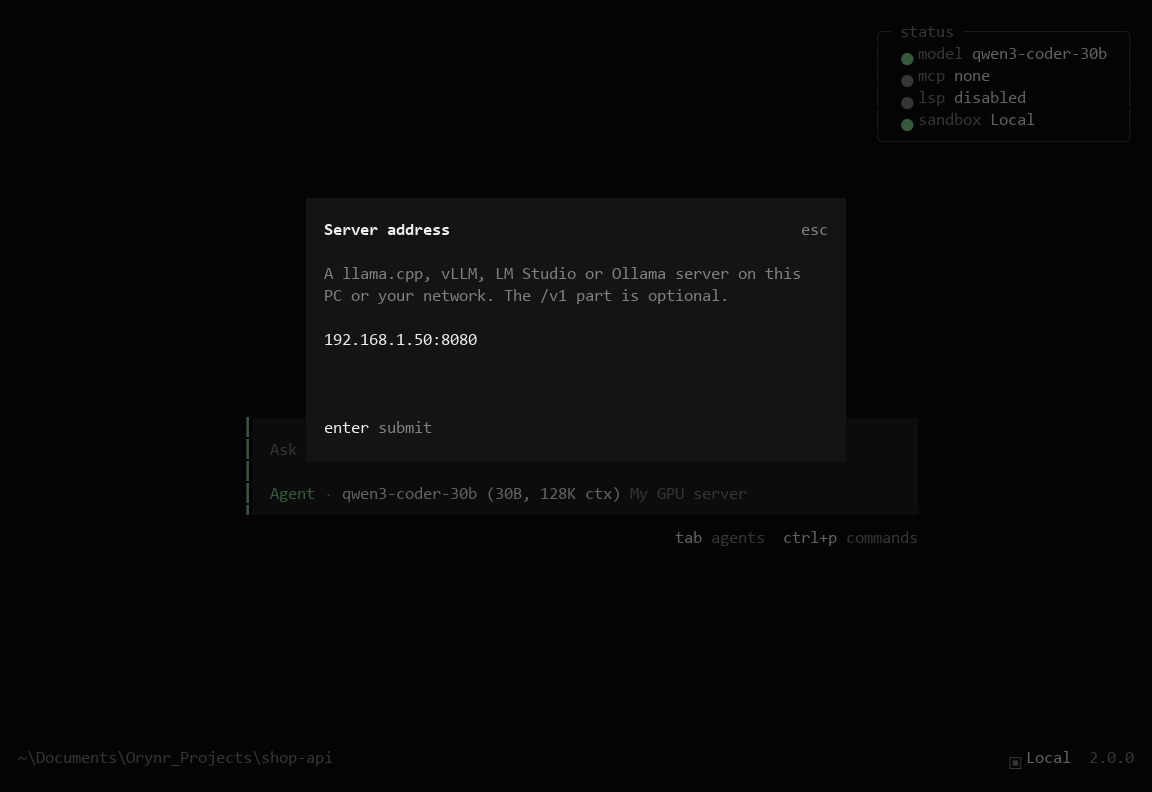
http:// and /v1 are optional.Orynr Code asks the server what it's serving before saving anything, and tells you plainly if the address, port or key is wrong. It then lists the model that's really loaded, with its size and context length. Adding the same address again updates it.
Think mode
For local models that support it, press ctrl+t (or /variants) to switch between normal, think and think harder. The model's reasoning streams live in a collapsible Thinking block, then the answer.
Projects & folders
Each project lives in its own folder, normally Documents\Orynr_Projects\<name>, with its own chats, settings and memory. You can also work in any existing folder by naming it in a new chat, or with ora C:\path.
A whole drive, the Windows folder, program folders and your home folder itself can never be used as a project.
Sandbox modes
Every project runs in one of three modes. /sandbox shows the current one and switches it; Orynr Code moves the files for you, never overwrites anything, and undoes a move that fails part-way.
Docker
The project's files sit in their own folder and only that folder is given to a locked-down container. Every command runs inside it. The container reaches the internet only: not your PC, not your home network.
Docker shared local
The same locked-down container, working directly on your project folder.
Local
Commands run straight on your PC. Fastest, and the default when Docker isn't installed.
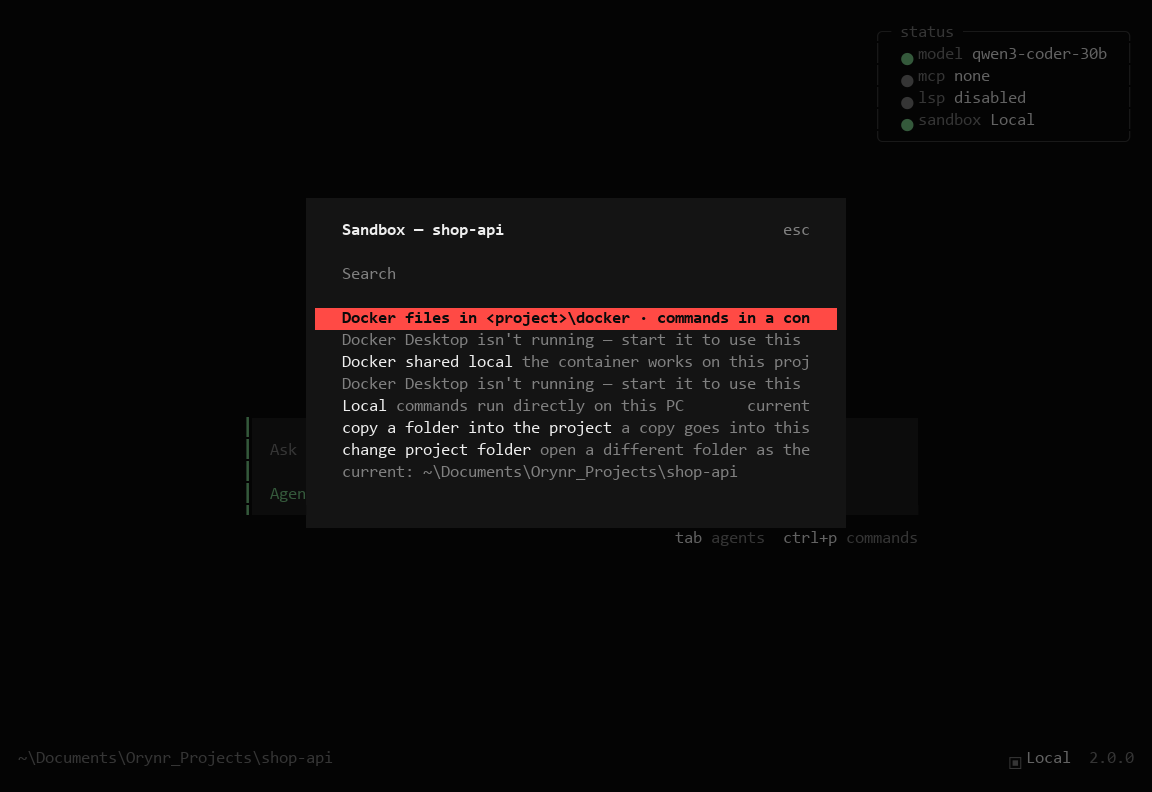
/sandbox. Here Docker Desktop isn't running, so the Docker modes say so and the project stays Local.- Docker modes need Docker Desktop. New projects start in Docker mode when Docker is running, and in Local mode otherwise.
- Copy a folder in: from
/sandbox, pick any folder on your PC to copy into the project. The AI itself can never reach your other folders. - In Docker modes nothing from the project runs on your PC, so code intelligence and the app preview are off there. Build, test and run inside the container instead.
For quick snippets there's also a separate safe code runner (Python, JavaScript, Ruby, PHP, Lua) that can't touch your machine at all.
MCP tool servers
MCP servers give the agents new tools: a database, GitHub, your company's API. Once connected, every agent can use them.
- Open the MCP screen:
/mcps(or ctrl+p → MCPs) → + Add a server. - Choose A web address (remote server) or A program on this PC (local server).
- Remote: paste the address, often ending in
/mcpor/sse. Local: type what starts it, likenpx -y @modelcontextprotocol/server-github, or the path to a server file. Paths with spaces are fine. - Give it a name, and a key if it needs one: for a web address, a token (sent as Authorization: Bearer, or type
Header-Name: valuefor another header); for a program,NAME=value, for exampleGITHUB_TOKEN=….
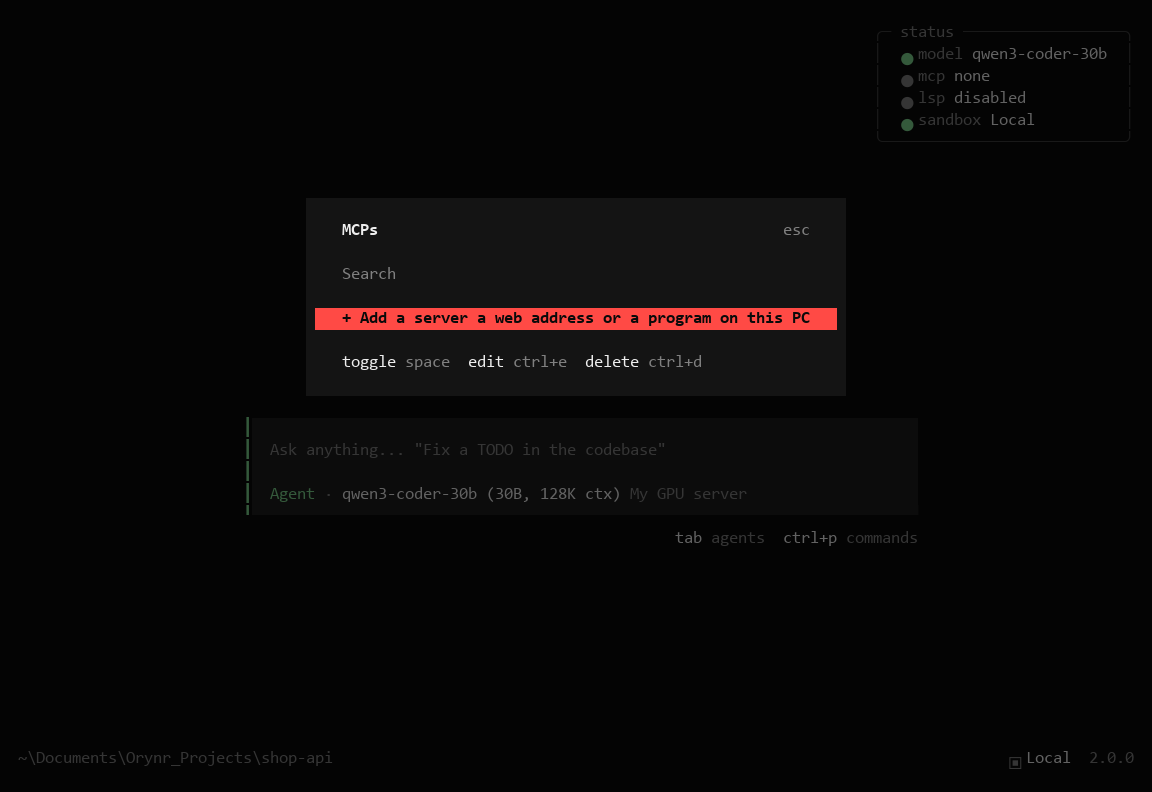
/mcps. Connected servers are listed here; space switches one on or off.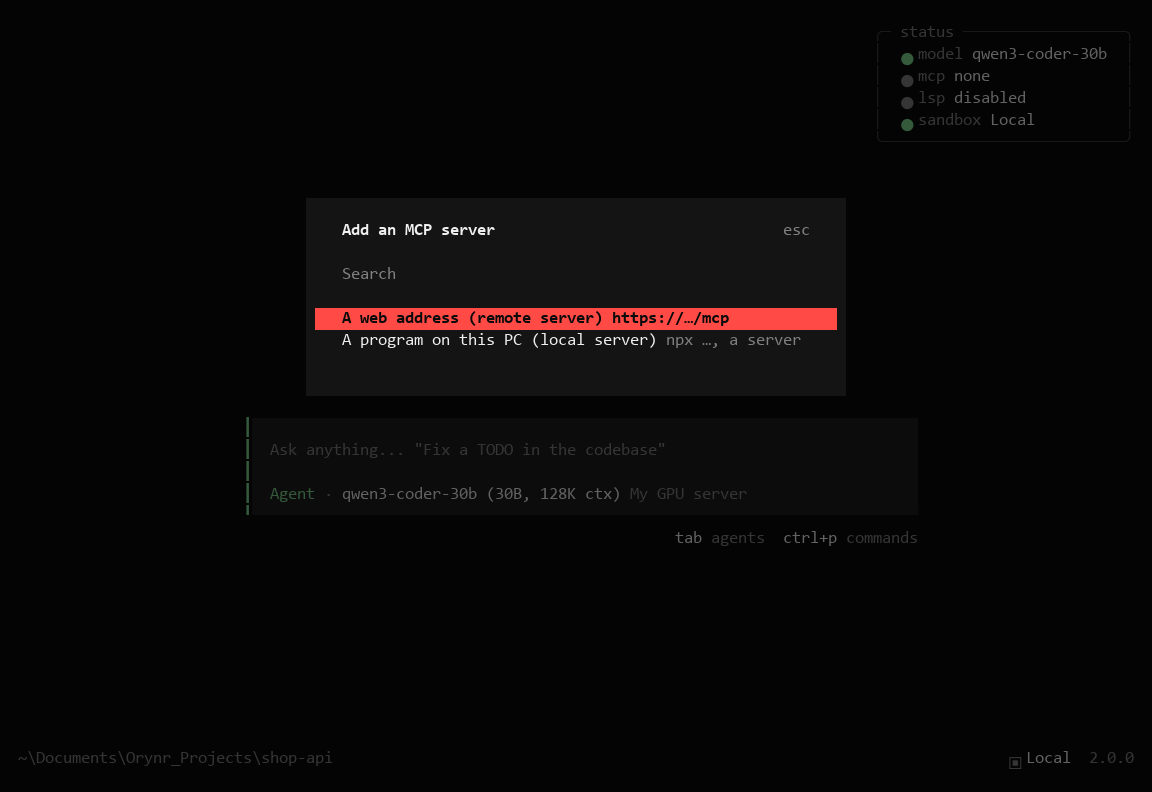
Orynr Code connects and lists the server's tools before saving it, and says plainly what went wrong if it can't. Keys are stored encrypted, never in a settings file. A server on your own PC or network needs one extra “Allow it, it's mine”.
npx servers need Node.js installed; servers written in Python need Python installed. Web-address servers need nothing extra.
Skills, plugins & memory
- Project memory. The agents save what they learn about a project (decisions, fixes, conventions) and a map of the codebase, and each new session starts with a short since last time brief.
/memoryshows it;/rememberadds to it. - Project instructions. Put guidance for the agents in
ORYNR.md(orCLAUDE.md) in your project./initwrites one for you by analysing the project. - Skills (
/skills) add know-how, including skills written for Claude Code. - Plugins can add tools, hooks and permission rules. Custom agents can be added in settings, or created by the Agent itself.
- Trust. A project's own tools, skills and settings only load once you trust the project (
/trust).
How Orynr Code protects you
Most of this is simply how it's built.
It asks before it acts
Commands and file changes need your approval unless you've allowed that kind of action, and “always” never lets a chained or hidden command through.
A container that can't see your PC
In Docker mode the project runs in a container that reaches the internet and nothing else, as an ordinary user with special privileges removed.
Everything can be undone
Every message snapshots your project first, so /undo can always put your files back.
Keys stay encrypted
Model and MCP keys are stored with AES-256, locked to your Windows account, never in plain text.
Tamper-evident software
The setup and every program are signed by Orynr LLC, and each release has a published SHA-256 fingerprint.
Nothing runs where it shouldn't
System folders, whole drives and your home folder can't become a project, and a project's own tools only load once you trust it.
Privacy & your data
- Runs on your computer. Your projects, chats and settings stay on your machine.
- No telemetry, no analytics, no account. Orynr Code sends nothing to Orynr.
- Data leaves only where you send it. Your messages, and the files needed to answer them, go to the model provider you chose. A web search, a page it fetches for you, or a tool server you connected get what they need. A server you run yourself keeps everything in-house.
- Your work is yours. You own the code you create with Orynr Code.
Troubleshooting
Fixes for the things people actually hit. Still stuck? Ask the Agent to diagnose it.
Typing ora says it isn't recognized
Open a new Command Prompt or PowerShell window. A window that was already open before you installed doesn't know about ora yet. Also check the spelling: it's ora.
“Windows protected your PC” when installing
Click More info → Run anyway. Windows shows this for software it hasn't seen many downloads of yet. To be sure your copy is genuine, compare its SHA-256 with the one on the download page (see Installing).
“The model provider rejected the credentials”
The API key was refused by the provider (a 401). Check it's the right key for that provider, still active, and that the account has credit, then add it again from ctrl+x m → ctrl+a. A refused key isn't retried, because it would fail the same way.
My own model server isn't found
- “Nothing answered”: check the address and port, that the server is running, and that it listens for other machines (start it on
0.0.0.0, not only127.0.0.1) with its port allowed through the firewall. - “Refused the API key”: the server was started with a key; type the same one.
- “Not an OpenAI-compatible model server”: something answered, but on the wrong port.
The first answer is very slow
Large local models load on the first request, which can take a while. The screen says so while it waits. After that it's much faster.
It says “trying again, attempt 2 of 6”
The model didn't answer or couldn't be reached for a moment, so Orynr Code is trying again with a pause in between. If all 6 tries fail it tells you plainly; check the model server or your internet connection.
It keeps asking for approval
Choose Allow always for the kind of action you're happy with. It covers that program (or any file, for edits) from then on. A different program, or a chained command with a part you haven't allowed, still asks, on purpose. To stop the asking entirely, /permission → Auto Approve.
“No project yet”: it won't write or run anything
The chat is still in the projects folder. Agree a name for a new project, or name an existing folder (“work on C:\…\MyApp”), and it carries on inside that project.
Docker mode says Docker isn't running
Start Docker Desktop and try again, or switch the project to Local with /sandbox. The first command in a new Docker project takes a little longer while the container is prepared.
An MCP server won't connect
- “That program wasn't found”: install what it needs (Node.js for
npx, Python for.pyservers) and check the command. - “Refused the key”: check the token, and the header if the server expects one other than Authorization.
- “Not an MCP server there”: check the full address; it often ends in
/mcpor/sse.
The Agent calls me by the wrong name
That comes from the project's memory, not from Orynr Code itself. Say “forget calling me …”, or see and edit it with /memory.
Still stuck?
- Ask the Agent: “diagnose why X isn't working.”
/statusshows the model, the tool servers and the sandbox at a glance.- Ask on the forum, or email info@orynr.com.
Frequently asked questions
Is Orynr Code really free?
Yes, free to use, including for commercial work, when downloaded from orynr.com. You pay a cloud AI provider only if you choose one; a model you run yourself costs nothing extra.
Which AI models can I use?
Any of 75+ cloud providers with your own key, or your own server: llama.cpp, vLLM, LM Studio, Ollama or anything OpenAI-compatible, on this PC or your network.
Does it work offline?
It needs a reachable model. With a model server on your own PC or network, no internet is needed for the AI. Cloud models, web search and online tool servers need internet.
Is my code sent to Orynr?
No. There's no telemetry and no account. Your code only goes to the model provider you choose, and only what's needed to answer you.
Do I need Docker?
No. Without Docker, projects run in Local mode. Install Docker Desktop if you want the internet-only container, then switch with /sandbox.
Mac or Linux?
Windows 10 and 11 (64-bit) for now. There's no Mac or Linux installer yet.
What's the difference between the Agent and Build?
Agent works out what you need and runs a team: it delegates, reviews and reports. Build does the work itself, directly. Start with Agent; switch with Tab.
How do I update?
Download the new setup from orynr.com and run it over the old one. Your settings, keys, projects and chats are kept.
Who is responsible for what it does?
Orynr Code is a tool that acts on your instructions and approvals, so what it does is your responsibility. AI output can be wrong, so review its work before relying on it, keep backups, and use the sandbox for anything you don't fully trust. The licence you accept when installing has the details.
Who makes Orynr Code?
Orynr LLC, Florida, USA. Contact: info@orynr.com.
No help topics match that search. Try a different word, or ask the Agent.